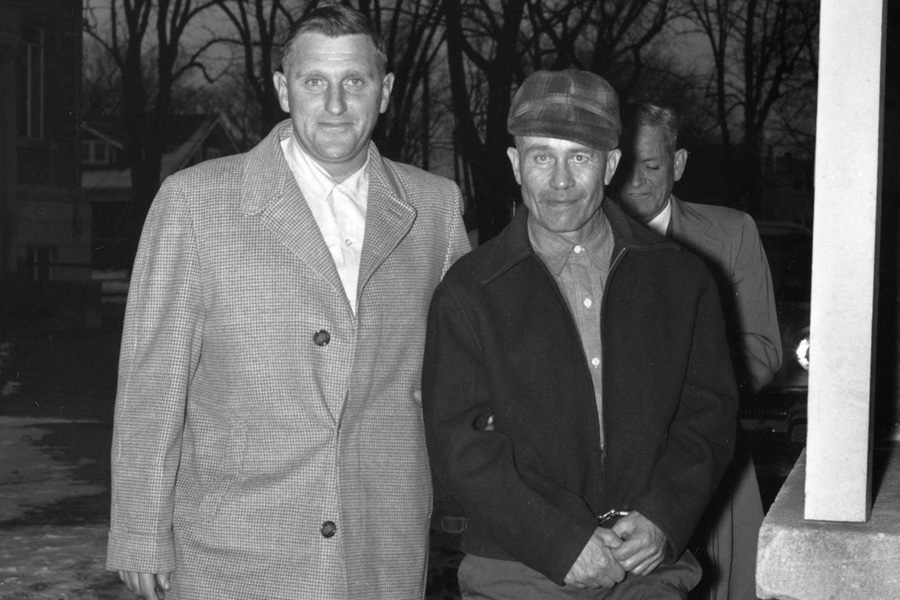
Basic Information
| Field | Details |
|---|---|
| Full Name | Henry George Gein |
| Birth | January 8, 1901 — La Crosse, Wisconsin, United States |
| Death | May 16, 1944 — near Plainfield, Wisconsin, United States |
| Parents | George Philip Gein (1873–1940); Augusta Wilhelmine (Lehrke) Gein (1878–1945) |
| Sibling | Edward Theodore “Ed” Gein (1906–1984) |
| Occupation | Farm laborer; worked on the family farm near Plainfield |
| Primary Residence | Rural Plainfield area, Waushara County, Wisconsin |
| Burial | Plainfield Cemetery, Plainfield, Wisconsin |
| Notability | Elder brother of Ed Gein; death during/after a marsh-and-brush fire in 1944 officially ruled non-criminal |
The Plainfield Farm: Early Years and Work
Set against the marshes and sandy soil of central Wisconsin, Henry George Gein’s life unfolded in the steady rhythm of rural work. Born at the dawn of the twentieth century in La Crosse, he moved with his family to the Plainfield area in the 1910s, where the Geins purchased a farm and built a life defined by chores, seasons, and the stern cadence of his mother’s household. In an era when small farms asked everything of a family, Henry’s days would have been familiar: tending livestock, mending fence, cutting wood, and fighting back the creeping edge of marsh and brush.
He was not a public figure, not a businessman with ledgers or a civic leader with speeches. He was a working man, rooted to a place—the kind of person who rarely leaves much of a paper trail but whose life anchors a family through steady labor. If the Gein farm was a small world, Henry helped keep it turning.
Family Map: Parents and Brother
The Gein household was a tight triangle of influence: a father with uneven fortunes, a mother with a commanding presence, and two sons who grew up largely in her shadow.
- George Philip Gein, the father, worked as a tanner and carpenter and once ran a small grocery before the family settled into farming. He died in 1940, leaving the farm’s daily burdens to his two sons.
- Augusta Wilhelmine (Lehrke) Gein, the mother, held strong religious convictions and exerted rigorous control over the home. Her rules set the tone: austere, insular, and moralizing.
- Edward “Ed” Gein, five years younger than Henry, would later draw national attention for grave-robbing and killings discovered in 1957. In the 1930s and early 1940s, before the storm, he was simply Henry’s younger brother and Augusta’s dependent son.
A family this small can feel like a pressure cooker. The brothers’ world was bounded by farm fields and a mother’s unyielding expectations.
A Brother’s Distance: Personality and Relationships
Accounts of Henry’s temperament paint him as more skeptical of the household’s strict ambience than his younger brother. While he worked the farm like Ed, Henry reportedly pushed back at times against Augusta’s iron grip. He is said to have worried about Ed’s intense attachment to their mother and, unlike Ed, to have courted an independent adult life—reports describe Henry seeing a divorced woman and even contemplating moving in with her.
These glimpses suggest a man with a foot on each side of a fence: loyal to family and farm, yet aware of a wider world. Even so, his life remained local, practical, and largely private. If Ed seemed increasingly fused to Augusta’s worldview, Henry appears to have looked for a path that included, but did not end at, the Gein farm.
The Fire of 1944: Death and Aftermath
On May 16, 1944, a brush-and-marsh fire near the farm drew attention and, by day’s end, tragedy. Henry went missing and was later found dead. Contemporary officials recorded the death as non-criminal—variously as asphyxiation or a heart attack sustained amid smoke and heat. For the people on the ground that day, it was a rural misfortune: a man overcome in a dangerous, all-too-common chore.
Years later, after Ed’s arrest in 1957 and the grim revelations that followed, Henry’s death was reexamined in the court of public memory. Some biographical accounts surfaced details such as alleged head bruising and the absence of a formal autopsy, seeding speculation that foul play could not be entirely ruled out. But the record from 1944 stands: authorities did not classify Henry’s death as a homicide, and there was no official criminal proceeding tied to it. The embers of rumor continue to glow, but the law’s ledger for Henry closes on an accidental or natural cause.
For the family, the blow was immediate. Henry’s death left Augusta and Ed alone on the farm. Within a year and a half, Augusta herself would die, and Ed’s life would contract sharply—fewer ties, more isolation, a house and mind collecting silence like dust.
After Henry: The Collapsing House
The years 1944 to 1945 remade the Gein household. With Henry gone, Augusta’s health and oversight became the single pillar of the home. When she died in late 1945, Ed was left largely to himself, tending a farm that felt increasingly like a museum of frozen rooms and vanishing possibilities. People would later search those years for clues—how the loss of a balancing brother and then an absolute mother altered the geometry of a troubled mind.
Henry’s story, set against that arc, reads like a quiet prelude to a storm. He does not move in headlines; he moves in the margins—in dates on a stone, a farm’s ledger of chores, a death notice in a local paper. Yet his absence shaped everything that followed.
Extended Timeline
| Date | Event |
|---|---|
| January 8, 1901 | Birth of Henry George Gein in La Crosse, Wisconsin |
| Early 1910s | Gein family moves to a farm near Plainfield, Wisconsin |
| 1930s | Henry works the family land alongside his father and younger brother |
| 1940 | Death of father, George Philip Gein |
| May 16, 1944 | Henry is found dead after a brush-and-marsh fire; officials rule death non-criminal (asphyxiation/heart attack) |
| December 29, 1945 | Death of mother, Augusta Wilhelmine Gein |
| November 1957 | Ed Gein is arrested; Henry’s 1944 death is revisited in public discussion but not reclassified by authorities |
The Workday World: What Henry Likely Did
Rural life in Waushara County in the 1930s and 1940s demanded range. A man learned to repair what broke, to coax harvest from poor soil, and to share long, cold months with a stove and the patience to endure them. Henry’s “career,” such as it was, blended tasks: mucking out stalls, hauling wood, patching a roof, or dragging green brush into burn piles to hold back the marsh. The calendar, not a job title, defined the work. It was ordinary, underpaid, and indispensable—the sort of labor that keeps a place alive.
A Life Tallied in Small Facts
There are more questions than documents when it comes to Henry: no known public service records, no published letters, no memoirs. What remains are the hard points—birth and death dates, a burial site, a family constellation—and the recollections gathered by later writers who interviewed locals. From these, a portrait emerges: an elder brother with a working man’s stoicism, sometimes at odds with his mother’s severity, mindful of his brother’s dependence, and perhaps ready, by the early 1940s, to step beyond the fence line of the family farm.
If a life is a ledger, Henry’s is written in pencil and field dust. Yet the figures still add up: a son who shouldered his share, a brother who wondered about another’s path, and a man whose death left a quiet but consequential gap.
FAQ
Who was Henry George Gein?
He was the elder son of George and Augusta Gein, a farm laborer who lived quietly near Plainfield, Wisconsin, and the older brother of Ed Gein.
How did Henry George Gein die?
He was found dead on May 16, 1944, after a marsh-and-brush fire; officials recorded his death as non-criminal, citing asphyxiation or a heart attack.
Was Henry’s death ever ruled a homicide?
No; despite later speculation, authorities at the time did not classify his death as a homicide.
Where is Henry buried?
He is buried in Plainfield Cemetery in Plainfield, Wisconsin.
Did Henry have a career outside the farm?
No public evidence indicates a career beyond working the family farm and performing local labor common to rural life.
What was Henry’s relationship with his mother, Augusta?
He reportedly disagreed with her at times and was more independent-minded than his younger brother, though he remained part of the household.
Did Henry’s death affect Ed Gein?
Yes; it left Ed alone with their mother until her death in 1945, after which Ed’s isolation deepened markedly.
Was Henry ever married?
There is no record that he married; later accounts suggest he was seeing a divorced woman shortly before his death.